Tokenized money market funds: an institutional data guide

Tokenized money market funds are cash funds whose shares are issued and recorded as tokens on public blockchains. The fund still holds short-term government debt, repo and cash, but its share register lives onchain. Because every subscription, redemption and transfer is public, institutional teams can follow supply, holders, flows and collateral use directly from onchain data instead of waiting for periodic fund reports.
This guide explains how tokenized money market funds work, which structures exist, what data matters and how to analyze it. For live figures on the market, see Dune's Real-World Assets data.
What is a tokenized money market fund?
A tokenized money market fund (MMF) keeps the familiar fund structure, with an asset manager, custodian, transfer agent, administrator and auditor. What changes is the record of ownership. Instead of a transfer agent's private database, shares are represented by tokens on a blockchain, and the token ledger is either the official register or a mirror of it.
The underlying portfolio does not move onchain. The manager still buys Treasury bills, enters repo agreements and holds cash with a custodian. Investors hold a token that represents a claim on that portfolio, and the token's value tracks the fund's net asset value (NAV).
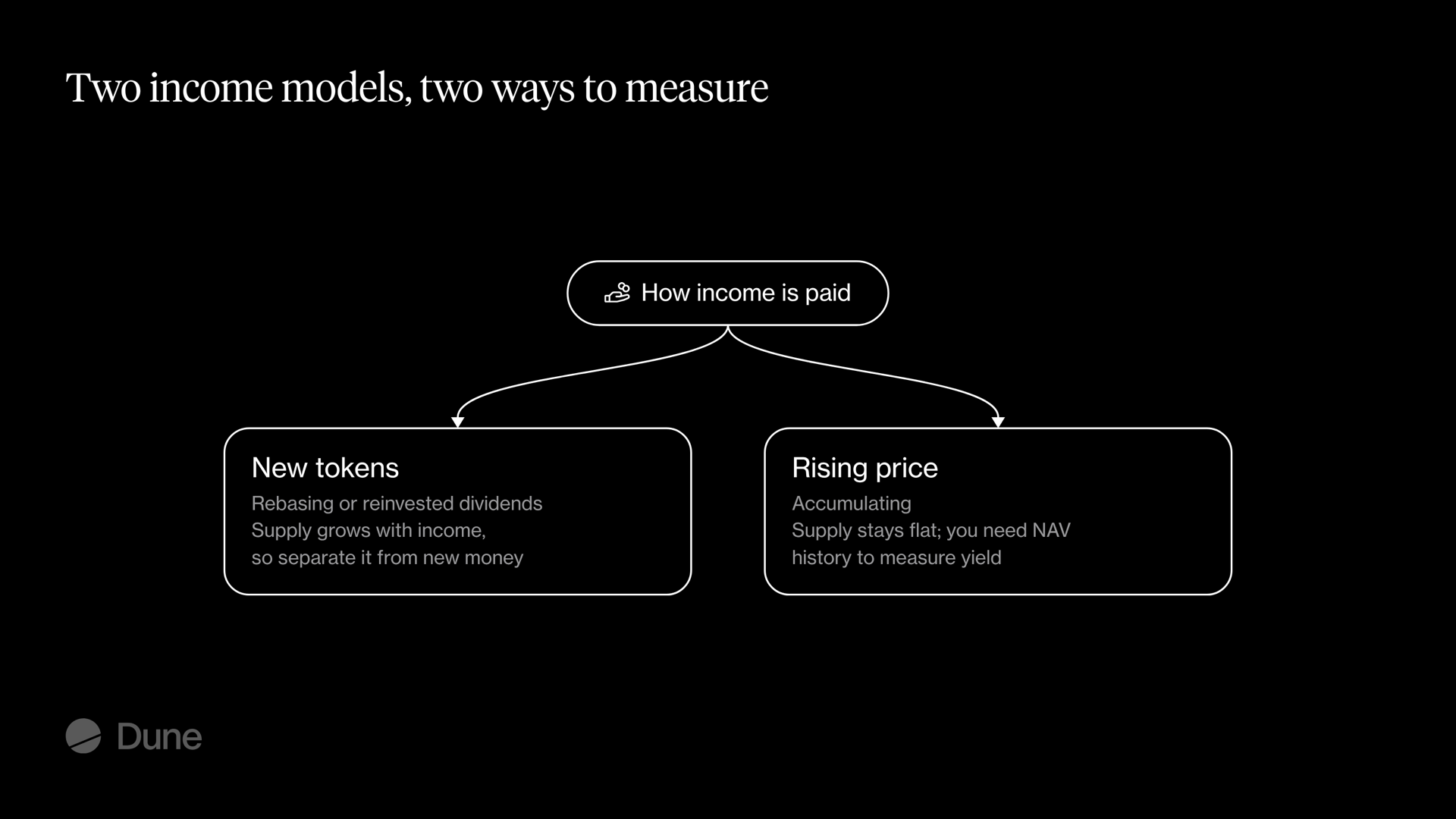
Most tokenized MMFs aim to hold a stable NAV per share and pay income in one of two ways: by issuing new tokens to holders (rebasing or dividend reinvestment), or by letting the token's price rise as income accrues (accumulating). Which model a fund uses changes how you measure it, as explained below.
How do tokenized money market funds work onchain?
The lifecycle of a tokenized fund share maps closely to traditional fund operations:
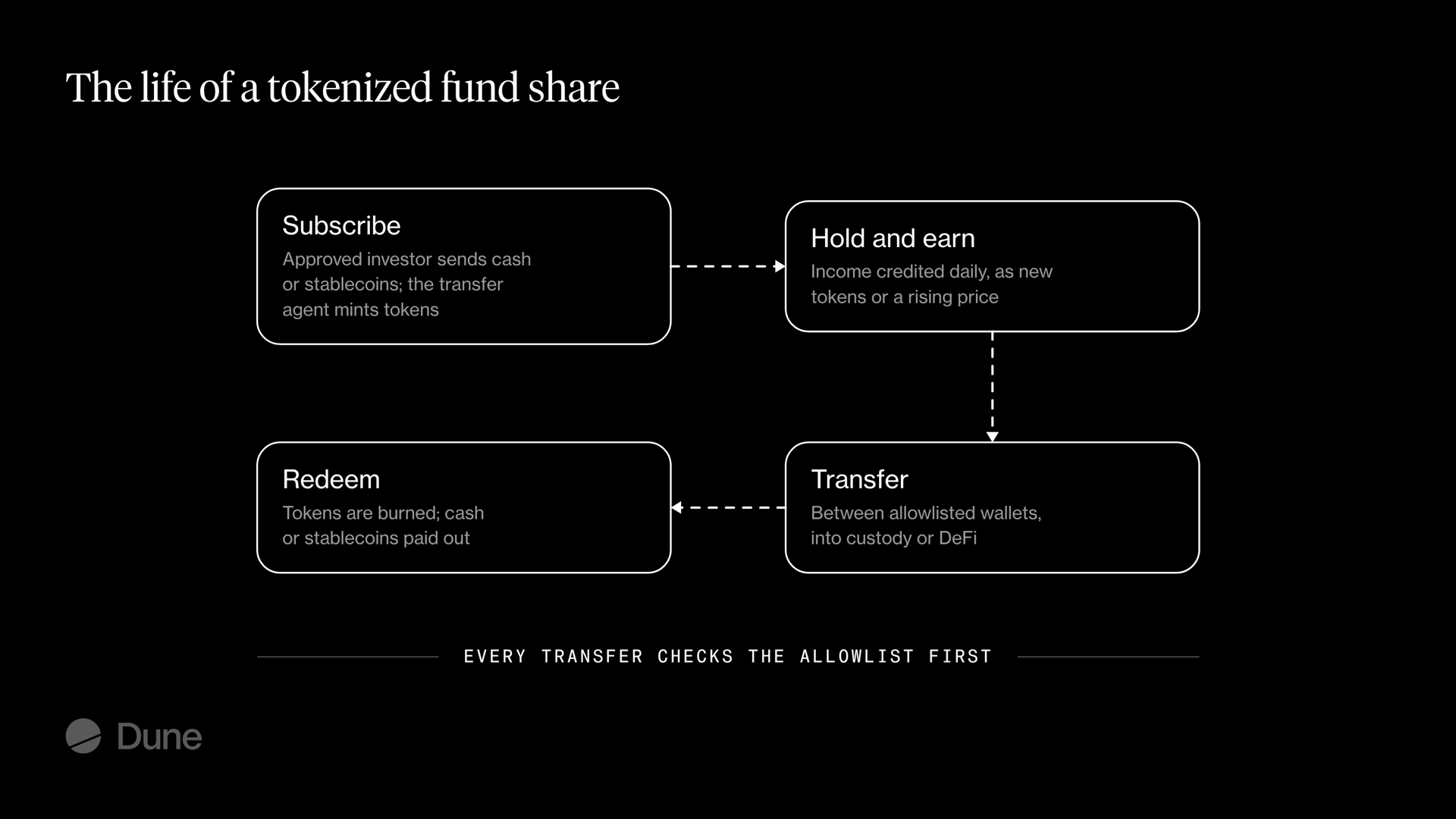
- Subscription. An approved investor sends cash or stablecoins to the fund. The transfer agent mints new tokens to the investor's wallet.
- Holding and income. The fund's income is credited daily, either as new tokens or through a rising token price.
- Transfer. Depending on the fund, tokens can move between approved wallets, into custody, or into DeFi protocols that accept them.
- Redemption. The investor returns tokens to the fund, the tokens are burned, and cash or stablecoins are paid out.
Almost all tokenized MMFs are permissioned. Smart contracts check an allowlist before a transfer settles, so only wallets that have passed KYC and investor-eligibility checks can hold the token. Many funds are limited to qualified purchasers, professional investors or non-U.S. persons, depending on the legal wrapper.
Which tokenized money market funds and structures exist?
Tokenized cash products come in several legal forms, and the form decides who can buy them and how they report.
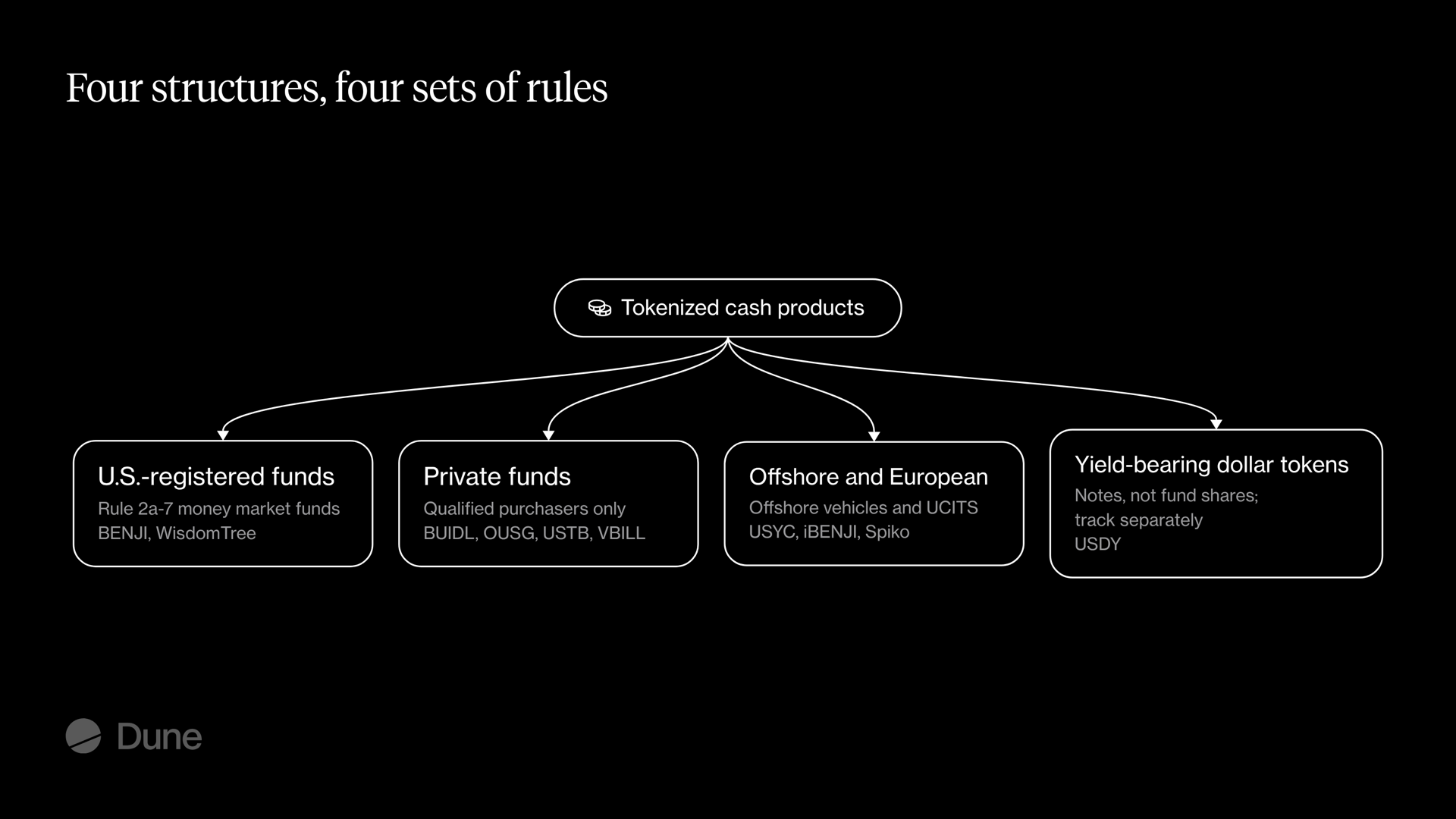
U.S.-registered funds. These are regulated as money market funds under the Investment Company Act and SEC Rule 2a-7. The Franklin OnChain U.S. Government Money Fund (token BENJI) was the first U.S.-registered fund to use a public blockchain to process transactions and record share ownership (Franklin Templeton). Other registered examples include the WisdomTree Treasury Money Market Digital Fund and token share classes launched by large managers such as JPMorgan and Fidelity.
Private funds for qualified purchasers. Many products are private funds offered under securities exemptions. BlackRock's USD Institutional Digital Liquidity Fund (BUIDL), tokenized by Securitize as transfer agent, is the best-known example (Securitize). Ondo's OUSG, Superstate's USTB and VanEck's VBILL follow similar structures.
Offshore and European funds. Some issuers use offshore fund vehicles or European UCITS funds for non-U.S. investors. Circle's USYC, Franklin Templeton's institutional iBENJI and Spiko's euro and dollar T-bill funds are examples.
Yield-bearing dollar tokens. Products such as Ondo's USDY are tokenized notes backed by Treasuries and bank deposits rather than fund shares. They are often grouped with tokenized MMFs as "tokenized treasuries", but they carry different legal rights and should be tracked as a separate category.
What data should institutions track, and why?
A fund factsheet gives AUM, yield and holdings on a set date. The chain gives a running record of who holds the shares and what they do with them. Five measures matter most.
Supply and AUM by chain
Most large funds now run on several chains. A single issuer-wide AUM number hides where supply sits and where it is growing. Track circulating supply per chain, then multiply by NAV to get AUM per chain.
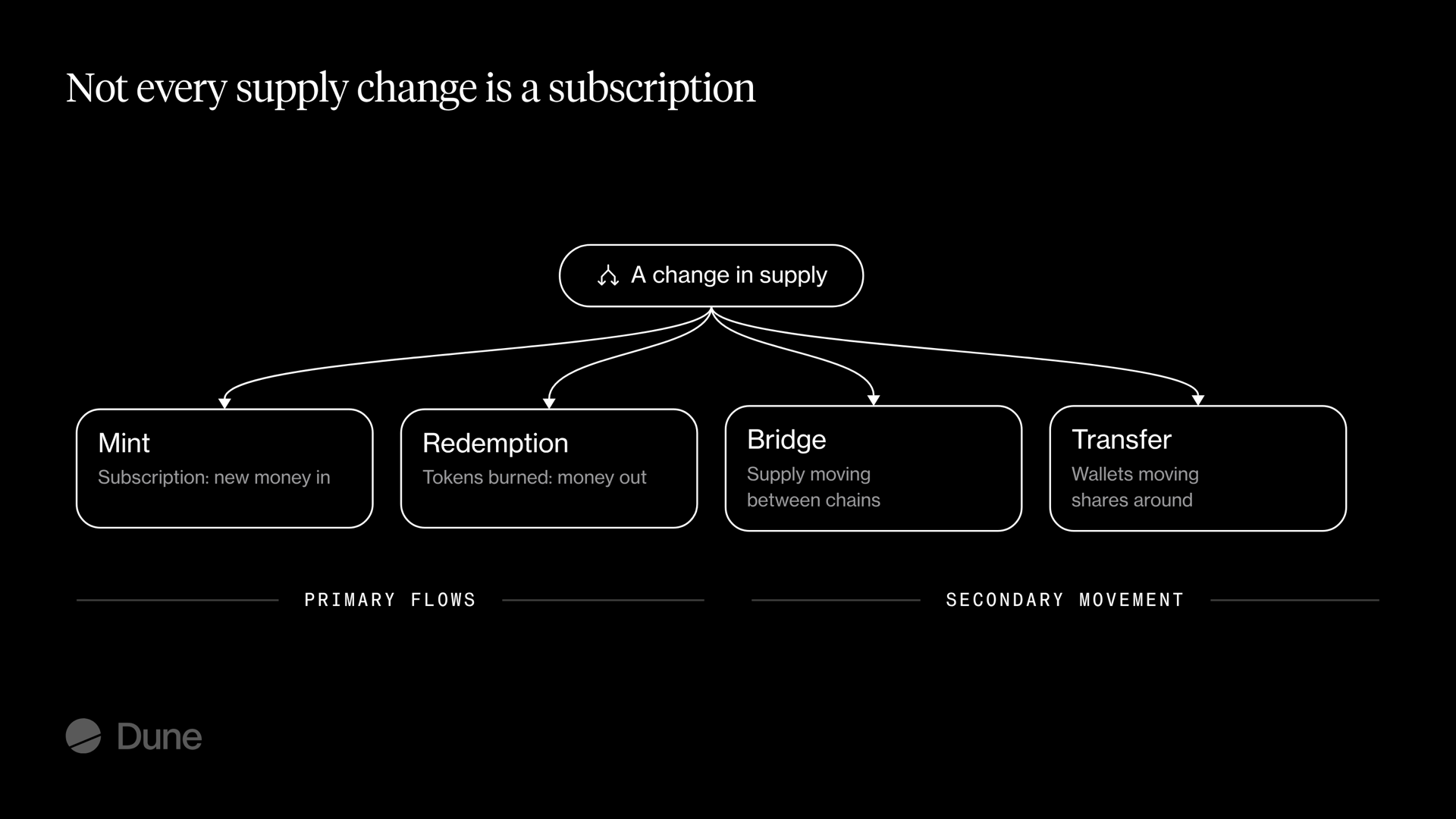
Primary flows versus secondary movement
Not every change in supply is a subscription. Classify supply changes by event type (mint, redemption, bridge or transfer) so primary flows separate from wallets moving shares around.
Holder concentration
Many institutional share classes have a small number of holders, and a few wallets can hold most of the supply. Concentration matters for redemption risk and for judging whether growth is broad or driven by one allocator or one protocol treasury. Labels on exchange, custodian, bridge and lending-pool wallets make holder lists far more useful.
Trading and liquidity
Tokenized cash rarely trades on secondary markets. Exits usually run through the issuer's redemption process, not an exchange. Thin trading makes a DEX price a poor guide to what a holder could realise in size.
Collateral use
A main argument for tokenized MMFs is that they can serve as collateral, earning yield while posted as margin or in lending protocols. Tracking how much supply sits in lending markets, collateral vaults and exchange accounts over time is one of the clearest tests of whether that use case is taking hold. Dune's After Issuance report looks at this across asset classes.
How do you analyze tokenized fund data?
Raw blockchain data needs four layers before it supports institutional analysis.
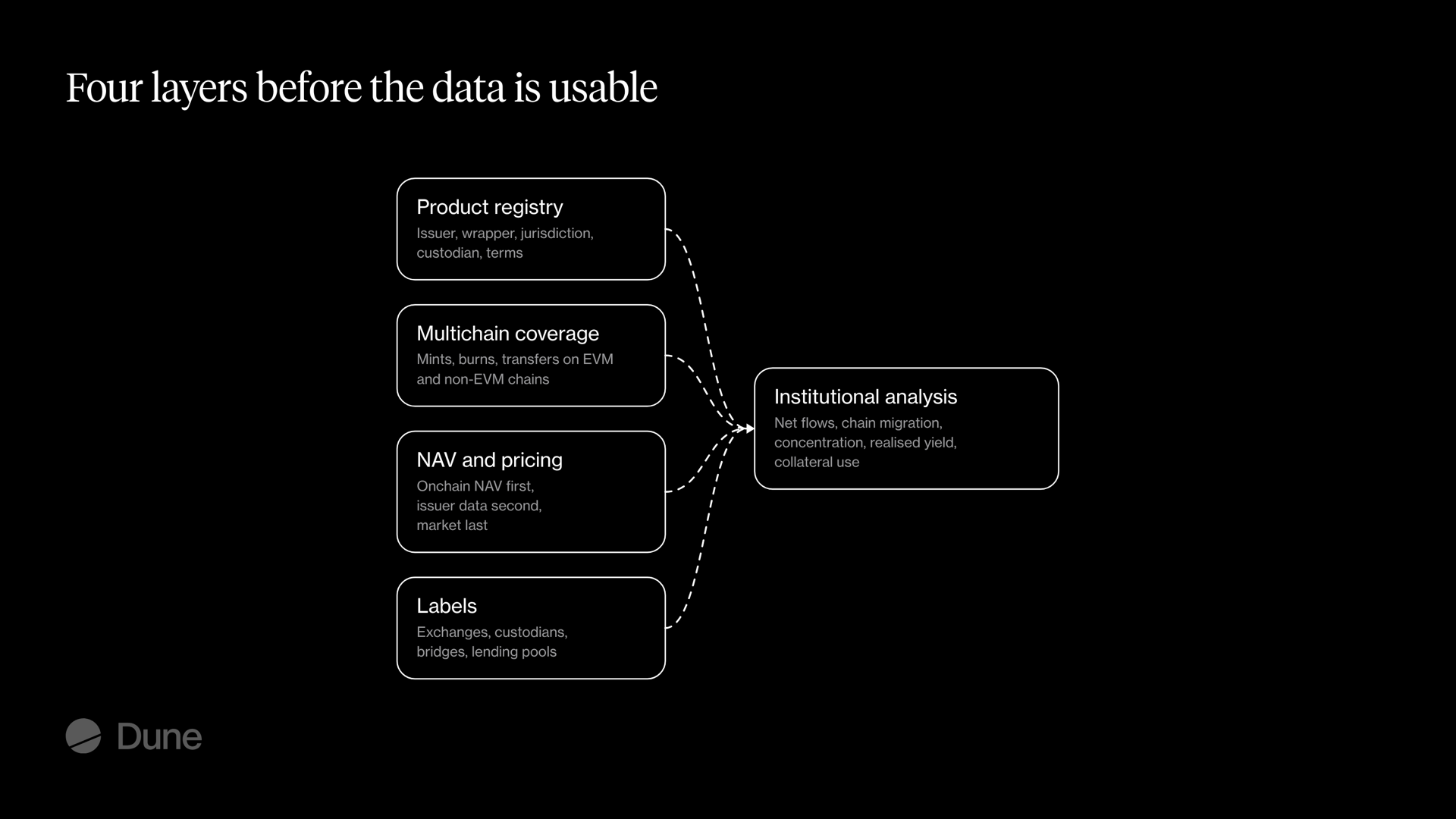
A product registry. Tokens must map to products, and products to issuer, asset class, legal wrapper, jurisdiction, transfer restrictions, custodian and redemption terms. Without this, you are comparing contract addresses, not funds.
Full multichain coverage. Transfers, mints and burns must be indexed on every chain a product touches, including non-EVM chains such as Stellar, Solana, Aptos and the XRP Ledger, where several large funds are deployed.
NAV and pricing. You need a defensible NAV source per product to turn supply into AUM: onchain NAV oracles first, issuer data second, market prices only as a last resort. Accumulating tokens need NAV history to measure realised yield.
Labels. Wallet labels for exchanges, custodians, bridges and lending pools turn holder lists into analysis of who is holding and why.
With those layers in place, common analyses include:
- Net subscriptions and redemptions per fund over time.
- Supply migration between chains.
- Holder count and concentration trends.
- Realised yield after fees compared with Treasury bills and other onchain yield sources. Dune's Institutional Yield Map compares these on realised return.
- Collateral and DeFi usage by protocol.
How Dune measures this
Dune's Real-World Assets dataset is built on the layers above:
- Registry first. Every token maps to a product with issuer, platform, legal wrapper, regulator, jurisdiction, custodian and transfer agent, so funds can be grouped by asset class and structure.
- Daily balances on every supported chain. Holder balances are taken as daily per-chain snapshots across EVM and non-EVM chains, with labels for issuers, exchanges, lending protocols, custodians and bridges.
- NAV-based valuation. USD values use each fund's onchain NAV or oracle price first, so value reflects accrued income rather than an assumed fixed price.
- Lifecycle events. Mints, redemptions and transfers are classified by event type, so primary issuance separates from secondary movement.
- Queryable tables. Teams with access to the RWA collection can query the same tables behind Dune's dashboards and reports in SQL, through the API or in their own data warehouse, and plug them into internal systems.
Who uses tokenized fund data?
- Asset managers and issuers monitor their own fund's supply, holders and chain footprint, and benchmark against peers. See Dune for asset managers.
- Banks and brokerages evaluating custody, distribution or collateral programmes use holder and flow data for due diligence. See Dune for banks and brokerages.
- Allocators and corporate treasury teams compare realised yield, concentration and redemption behaviour before allocating.
- Stablecoin and DeFi risk teams track tokenized MMFs used as reserves or collateral, alongside stablecoin data.
Bottom line
Tokenized money market funds bring a familiar, regulated product onto public infrastructure. That makes supply, holders, flows and collateral use observable in a way traditional funds never were, provided the data is mapped to products, covered across chains and valued at NAV.
Dune provides institutional-grade onchain data for teams and production level enterprises, including a multichain RWA dataset built for this kind of monitoring. Explore the Real-World Assets dataset or read the After Issuance report.