Stablecoins are no longer a crypto-native phenomenon. They're core financial infrastructure, powering cross-border payments, institutional settlement, DeFi liquidity, and an entirely new layer of programmable money moving trillions of dollars annually.
Up until now, enterprise teams and financial institutions building on top of stablecoins have been forced to stitch together raw chain data, maintain fragile custom pipelines, and accept incomplete cross-chain coverage. That's not a viable foundation for production systems.
Today, Dune changes that.
Introducing Dune's Stablecoin Datasets
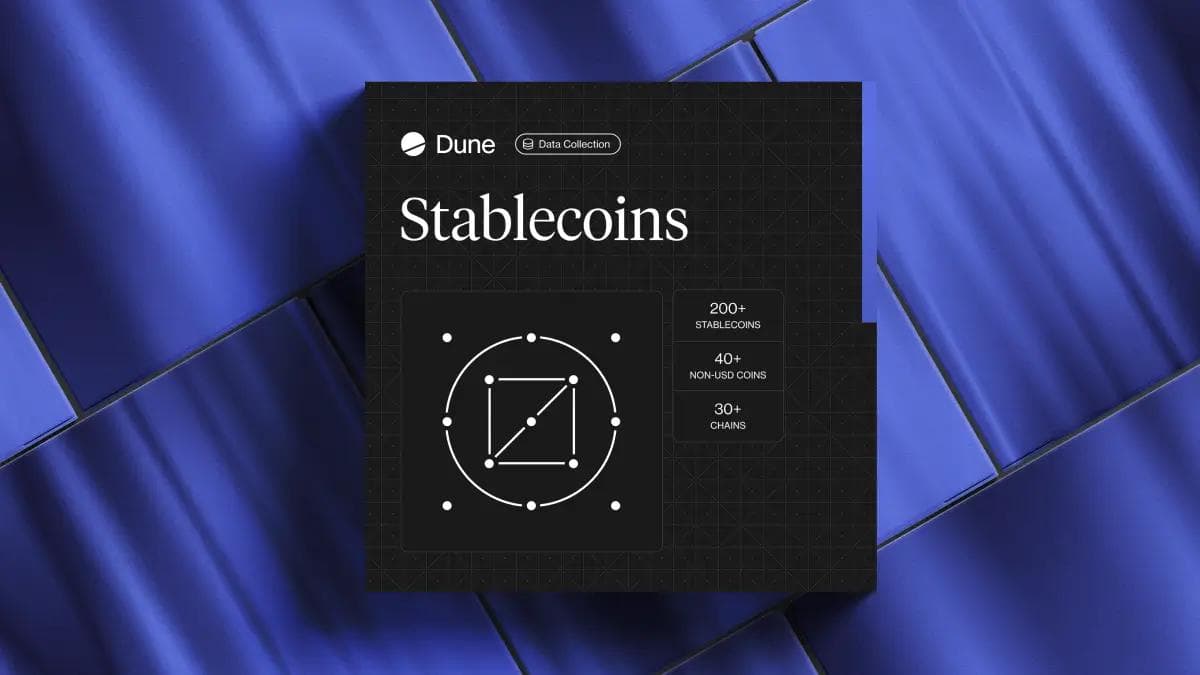
We're launching a production-ready suite of curated stablecoin tables, covering transfers and balances across EVM, Solana, Tron, and unified multichain views, built to the standards that enterprise teams and financial institutions actually need.
This isn't a research tool. It's a data infrastructure layer you can build on.
Blockchains covered in the dataset

Built for Production at Scale
Transfers (Free Access)
Reliable, normalized transfer data across EVM, Solana, and Tron, with currency, decimals, symbols, and prices included. Consistent schema across chains means your pipelines don't break when you expand coverage. Whether you're processing millions of rows for compliance reporting or powering a real-time dashboard, the data is ready.
Explore stablecoin transfers data →
Balances (Free Access)
Daily stablecoin balance snapshots for addresses across every supported network, with a unified multichain view that normalizes EVM, Solana, and Tron into a single table. Track balance shifts over time, monitor wallet-level exposure, and power portfolio or risk systems without rebuilding your data model for each chain.
Explore stablecoin balances data →
The enriched activity tables classify every transfer by project and activity type across 37 supported EVM chains and Solana (Tron coming soon). For compliance teams, payment processors, and financial institutions, this is the difference between raw event logs and actionable intelligence: is this transaction a DEX swap, a bridge, a payment, an exchange withdrawal? That classification layer is what makes the data useful at scale.
Get access to Enriched Activity tables
The enriched balances tables identify address types by economic function, such as exchanges, protocols, institutional wallets, retail, and flag whale-tier holders, normalized across EVM, Solana, and Tron (coming soon). For risk teams, investment analysts, and treasury functions, this is the holder intelligence layer that powers supply concentration analysis, counterparty exposure monitoring, and market structure research.
Get access to Enriched Balances tables
Use cases of the stablecoin dataset
These datasets are designed around the questions that matter to enterprise and institutional users:
- Supply and concentration analysis: who holds what, how concentrated is issuance, how is it shifting
- Transfer volume and flow tracking: where is money moving, at what scale, through which protocols
- Cross-chain comparisons: normalized views across EVM, Solana, and Tron without custom reconciliation work
- Address behavior classification: distinguish institutional flows from retail, identify exchange activity, flag unusual patterns
Stablecoins are becoming the default settlement layer for global finance. The teams that build on reliable data infrastructure now will be the ones defining how that market is understood, monitored, and navigated.
Start building on Dune's stablecoin datasets today.
The Most Comprehensive Stablecoin Dataset Just Landed on Dune