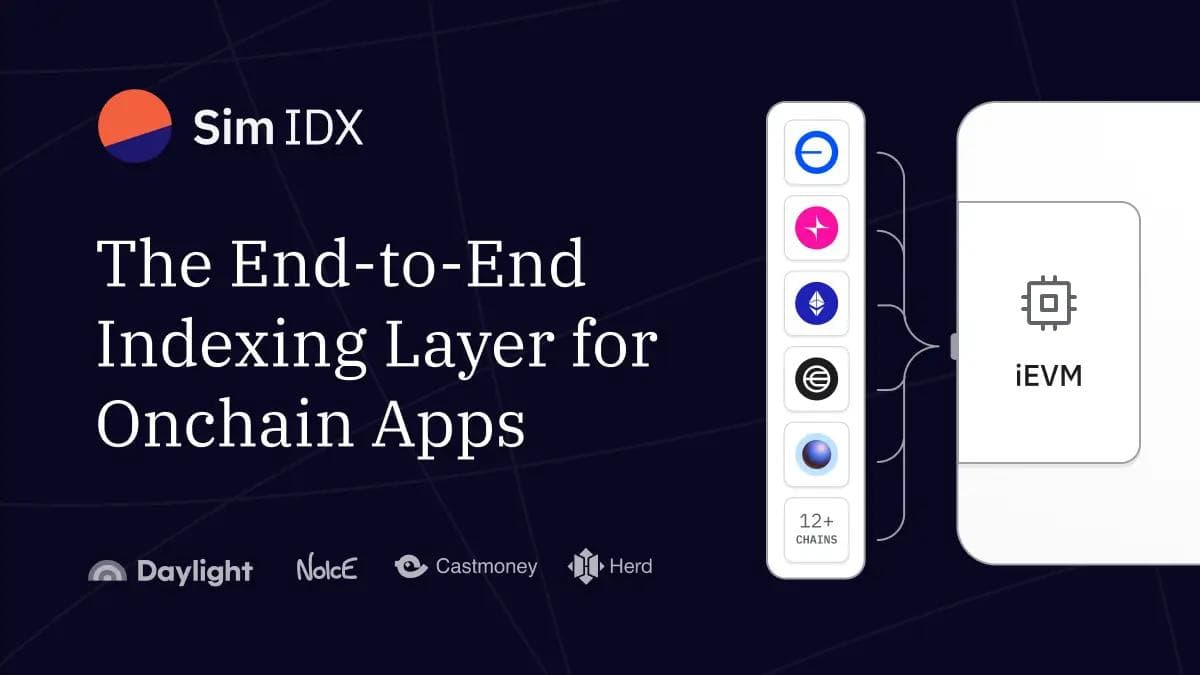
A month ago, we launched our newest multichain, realtime developer platform, Sim, with a full suite of APIs designed for wallet use cases. Today, we are excited to bring to you Sim IDX, a new product line that will expand your capability to build with Sim.
For too long, developers building onchain applications have wrestled with the inherent tradeoffs of traditional indexing solutions. Most existing blockchain indexes operate on a familiar, yet limiting, model: A transaction is executed on a full node. After execution completes, data is extracted from the node. This data is then transformed and loaded into an external database.
This seemingly simple flow forces developers into tough compromises:
- Real-time vs. Safe: You might sacrifice protection against chain reorganizations (reorgs).
- The Black Box: Gaining deep insight into what happened during execution – the crucial intermediate state changes within a single transaction – is often incredibly difficult or impossible to get with event-based systems.
- Operational Overhead: Managing node infrastructure, keeping syncs running, and scaling databases becomes a significant burden, stealing time from core development.
- Indexing as Execution:
Your indexing logic runs directly within this iEVM, processing blocks as they execute, not after. - Direct State Access:
This architecture grants the indexer unparalleled, fine-grained access to the entire state of the blockchain at every step.

The Impact: Speed, Precision, and Simplicity
This architecture was motivated by the need for more precise data, particularly for complex protocols like DeFi apps, where intermediate state changes within a single transaction can be just as important as final state. For complex protocols, seeing only the final state is like watching only the last frame of a movie. Sim IDX captures the entire narrative within a transaction.
For example, capturing each price update in a volatile swap, rather than just the end result, can unlock new types of analysis and real-time responsiveness that event-based systems can miss.
Sim was also designed to simplify protocol-wide observability. Many projects need to track a large and dynamic set of contracts—such as every ERC-721 or every Uniswap V3 fork. With Sim, developers can define a single indexing job that targets all contracts implementing a given interface, eliminating the need for long, static address lists or multiple pipelines.
Finally, Sim IDX reflects a belief that developers should have both control and velocity. It supports Git-based workflows with preview environments, requires no node or DB maintenance. By moving indexing closer to execution and reducing operational friction, Sim is built to serve teams that need speed, accuracy, and flexibility as they scale.
We built Sim IDX because we believe blockchain data should be as rich, accessible, and immediate as the ecosystems it represents. By moving indexing into the execution layer itself, we're eliminating the friction and limitations that have held developers back.
Sim is launching today as a fully managed system, meaning that it'll be zero-devops and overhead for the team to manage the pipeline and start building with Sim. In the coming month, Sim will also roll out options for a self-hosted database for those who need more control over their set up.
Explore Sim IDX and see how it can transform your workflow: sim.dune.com