TheMoneyLayer:LATAMCrypto2025Report
Mapping how crypto powers daily life across Latin America
Research•August 18, 2025•36 min read

Filippo ArmaniData Content Creator at Dune
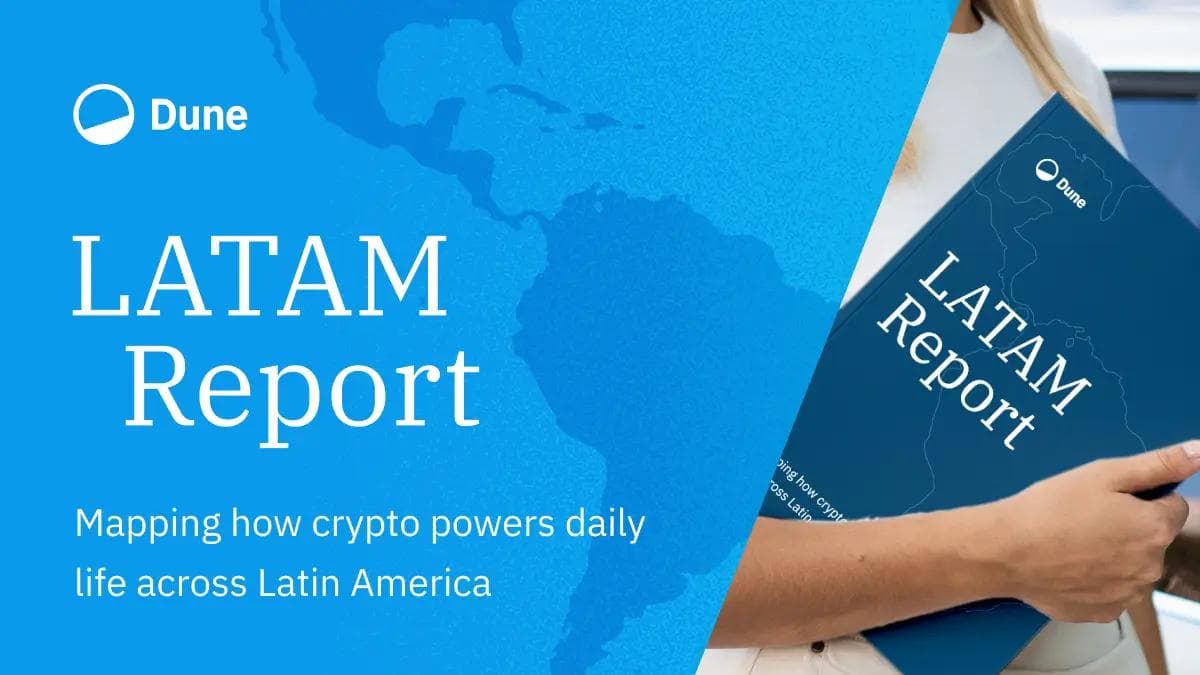
Across Latin America, crypto has evolved into a practical financial tool—used to save, send, and spend in everyday life. In a region shaped by inflation, currency volatility, and limited access to traditional banking, millions turn to crypto out of necessity, not speculation. This report focuses on the most urgent and impactful layer of adoption: crypto as money.
To navigate the region’s diversity, we frame our analysis around four pillars: exchanges, stablecoins, on-/off-ramps, and payment apps. Together, these form the infrastructure enabling real-world use—remittances, salaries, savings, and payments. Working closely with projects, we prioritized onchain, verifiable data via Dune dashboards, bringing visibility to the builders driving adoption.
While not exhaustive, this report is a first step toward a shared, transparent, data-backed view of crypto usage across Latin America. As the State of the Crypto Industry 2024 report by Lemon Cash illustrates, the region is large, fast-moving, and under-mapped, with usage patterns that vary sharply by country, from institutional flows and speculative retail in Brazil, to remittance-driven activity in Mexico, to heavy reliance on stablecoins in Venezuela and Argentina as a hedge against inflation. This diversity is why we focus on shared, practical use cases rather than treating Latin America as a single market.
This report also sets the stage for DuneCon 2025 in Buenos Aires this November, a full-day gathering of the LATAM crypto and data community, where many of the builders and projects featured here are expected to attend and connect with peers from across the region.
Stablecoins are the backbone of LATAM’s onchain economy – in July 2025, USDT & USDC made up over 90% of exchange volume; local stablecoins in Brazil and Mexico are scaling fast.
Exchanges have evolved into financial infrastructure – Annual flows grew 9× from 2021–2024, moving beyond OTC into integrated platforms serving retail, institutional, and cross-border needs.
On-/Off-Ramps are closing the gap – Permissionless protocols and regulated APIs are making fiat–crypto conversion faster and cheaper, with expanding corridor coverage.
Payment Apps are becoming crypto-native neobanks – Mobile-first apps combine savings, yield, and real-world payments, reaching both banked and unbanked users.
Want to go deeper? Join us at DuneCon 2025 – Buenos Aires, Nov 19 for talks, workshops, and networking with the region’s leading onchain builders and analysts.
This report would not have been possible without the generous support, insights, and collaboration of many individuals and communities across the Latin American crypto ecosystem.
Special thanks to Romina from ETHLatam for initiating this journey, sharing early leads, introductions, and invaluable context. To Joao from Picnic, for his help unpacking the Picnic x Gnosis Pay integration and for facilitating further industry connections. To Rex and Enti from Vista, for their sharp perspective on regional trends, a thoughtful overview of the LATAM landscape and their network of connections. To Rodrigo from Iporanga Ventures, for his pioneering work on local stablecoins adoption and Real-pegged assets. And to Alex Obchakevich from Obchakevich Research, whose leading-edge research into crypto payments and exchange activity on Polygon and multichain networks was instrumental to this report’s section on exchanges.
We’re also deeply grateful to vibrant communities like Espacio Cripto and Crecimiento, whose warm welcome and support energized this initiative.
Finally, heartfelt thanks to all the projects who took the time to speak with us, share data and context, and build dashboards on Dune, not only to support this report, but to help bring greater onchain transparency and insight to our shared communities.
Latin America stands out as one of the most vibrant regions globally for crypto adoption, shaped by economic volatility, financial exclusion, and everyday necessity. Faced with chronic inflation, persistent currency devaluation, and limited access to traditional banking, millions across the region have turned to crypto, not for speculation, not for fun, but for survival, stability, and efficiency.
In the year ending June 2024, the region received $415 billion in crypto value, with Brazil, Mexico, Venezuela, and Argentina ranking in the global top 20 for grassroots crypto adoption Chainalysis, 2024. The shift is visible in behavior: stablecoins are displacing Bitcoin as the most purchased crypto in markets like Argentina and Colombia, and trading activity reliably spikes around salary dates as users convert their pay into digital dollars to preserve value Bitso, 2024.
In this ecosystem:
Together, these pillars are creating a parallel financial system that is often more stable, more accessible, and more practical than the legacy alternatives.
Centralized exchanges remain the dominant entry point into crypto in Latin America. As of mid-2024, 68.7% of all crypto activity in the region occurs via centralized exchanges, slightly below North America but well ahead of other emerging markets (Chainalysis, Oct 2024). This reflects a user preference for trusted, familiar platforms that offer direct access to fiat rails and regulated interfaces.
According to Lemon’s 2024 report, Binance controls 54% of centralized exchange volume in Latin America, making it the undisputed market leader. Among regional players like Bitso, Foxbit, Mercado Bitcoin, Lemon leads with 15% market share, underscoring the role of local apps in serving user needs that global platforms may overlook (State of the Crypto Industry 2024 – Lemon). These platforms serve as critical infrastructure for onboarding users into the crypto economy. And have expanded beyond basic trading into areas like crypto payments, savings tools, and cross-border transfers.
At the institutional level, Brazil leads the region. The volume of transactions over $1 million increased +48.4% quarter-over-quarter from Q4 2023 to Q1 2024 Chainalysis, Oct 2024, fueled by greater TradFi interest, local ETF demand, and regulatory developments like the Drex pilot. Major banks such as Itaú and BTG Pactual have launched crypto investment services, further blurring the lines between exchange and bank.
Exchanges are also becoming more sophisticated. For example, Bitso Alpha, the exchange’s pro trading interface, saw increased usage in 2024, particularly during market peaks. Despite fewer users than Bitso Classic, Alpha accounts for comparable trading volume, highlighting the impact of engaged power users (Bitso, 2024).
Beyond individuals, SMEs across LATAM are using exchanges to settle cross-border payments and hedge against local currency depreciation. In Brazil, for example, crypto is used to avoid traditional banking fees when transacting with global suppliers, especially in Asia, who already accept Bitcoin or stablecoins (Frontera, Nov 2024).
The flow analysis below tracks the movement of assets from and to exchanges’ hot wallets, providing a direct view of the capital entering and leaving these platforms. Unlike trading volume, which reflects internal order book activity, these flows capture actual onchain value transfer, deposits from users, withdrawals to external wallets, and settlement with other counterparties. This makes them a valuable proxy for real exchange usage, liquidity demand, and the role these platforms play in on/off-ramping between crypto and the wider economy.
From early 2021 to mid-2025, the flow of assets through LATAM-based centralized exchanges traces a clear arc of growth, maturity, and consolidation, reflecting the region’s evolving relationship with digital assets. Overall tracked transfer volumes jumped from $3B in 2021 to $27B in 2024.
In 2021, annual volumes for the largest platforms were still modest by global standards. Bitso, the regional leader, processed around $2 billion, while Mercado Bitcoin handled roughly $1.2 billion. Other players such as Brasil Bitcoin and Ripio moved only tens of millions, underscoring how early the market still was. These years carried the aftershocks of the pandemic, with a global bull market fueling retail speculation, but in Latin America much of the activity remained fragmented across OTC desks, informal brokers, and a handful of formal exchanges. By 2022, the landscape began to diversify: newer entrants such as Lemon Cash started growing, moving close to $90 million in the first available year.
The real inflection point came in 2023, when regional exchange volumes more than quadrupled year-on-year. Bitso’s flows jumped from $2.48 billion in 2022 to $13.6 billion, while Lemon Cash nearly tripled to $260 million. This growth coincided with exchanges embedding themselves into payment ecosystems, remittance channels, and corporate treasury operations. Macroeconomic pressures, from persistent inflation to currency depreciation in Argentina and Brazil, intensified demand for stablecoins, making exchanges critical conduits for USD-denominated assets. By the end of the year, liquidity had begun concentrating in a few large platforms capable of serving both retail and institutional needs.
The market reached peak liquidity in 2024. Bitso’s volumes soared to $24.9 billion, dwarfing all previous years, while Mercado Bitcoin more than tripled year-on-year to $915 million. Lemon Cash also set records at $860 million. Crucially, this growth came in a year without a sustained global bull run, pointing to a shift from speculative trading toward real-world utility, such as cross-border commerce, remittance settlements, and hedging against local currency risk. By this point, the leading exchanges had become embedded in the financial fabric of the region.
The first months of 2025 brought a slowdown from these record highs, with January volumes marking a recent low. But from that trough, activity began climbing again month by month. By July 2025, total flows reached their highest point since September 2024, a sign that the structural adoption gains of the past two years remain intact despite the overall decline from last year’s peaks. Bitso’s cumulative January–July volumes, at $10.4 billion, were down from 2024’s pace but still several times higher than any pre-2023 year. Mercado Bitcoin reached $990 million, while Lemon Cash processed $810 million in just over half a year, a run rate close to its 2024 record. Smaller exchanges, by contrast, saw flat or declining activity, reflecting the continued concentration of liquidity among the largest, best-capitalized players.
Underpinning all of these flows is a clear technological pattern: Ethereum remains the backbone of LATAM exchange activity. From January 2021 to July 2025, Ethereum-based transfers accounted for over $45.4 billion in volume, roughly three-quarters of all recorded flows. This entrenched dominance reflects its role as the primary settlement layer for high-value transfers, stablecoins, and tokenized assets. Beyond Ethereum is Tron, with $12.38 billion, driven primarily by its role as the lowest-cost rail for USDT transfers, which are widely used in remittances and cross-border payments. Polygon ranks third with $1.1 billion in cumulative flows, and its share has been rising steadily in 2025, now making up around 8% of all monthly volume transferred. BNB Chain follows closely at $943 million, while Base ($23 million) and Arbitrum ($11 million) remain marginal. This concentration shows how LATAM exchange activity is anchored in a small number of networks that combine liquidity depth, stablecoin availability, and cost efficiency.
At the token level, the story is even clearer. As noted earlier in this report, stablecoins dominate the market: in July 2025, USDT and USDC together accounted for over 90% of all volume transferred. Over the full January 2021–July 2025 period, USDT has processed $32.4 billion, almost double USDC’s $18.36 billion, with the gap reflecting USDT’s central role on Tron. ETH is the third-largest asset overall, with $4.74 billion moved.
What’s striking is how the composition has shifted over time. In 2021–2022 and much of 2023, ETH often rivaled or even led stablecoins in volume share, and the top tokens list was more diverse, including native assets like MATIC and wrapped BTC. Since late 2023, however, stablecoins — and especially USDT and USDC — have expanded their share dramatically. This evolution likely reflects a broader change in the use cases driving exchange flows: away from speculative trading of volatile assets, and toward practical applications such as payments, remittances, merchant settlement, and on/off-ramping for dollar savings.
Other tokens still leave their mark: MANA and BUSD both exceed $500 million in cumulative flows, PEPE ranks unexpectedly high at $384 million, and BTCB, the BEP-20 version of Bitcoin, has moved over $90 million, showing demand for wrapped BTC on alternative chains. MATIC, once a top token thanks to Polygon’s role, has slid to $87 million as stablecoin activity has concentrated the market.
This shift in both blockchain and token composition points to a maturing LATAM exchange ecosystem: Ethereum remains the settlement backbone, Tron has carved out a dominant role in low-cost stablecoin transfers, Polygon is steadily increasing its share by carving out a role in payment-focused flows, signaling that these platforms are increasingly being used as payment and value-transfer rails rather than purely as speculative trading venues.
Lemon Cash’s footprint in context adds another layer to this picture. Proof of Reserve data shows the exchange holding around $100 million in assets under custody by mid-2025, with a portfolio heavily weighted toward stablecoins.
Stablecoin balances have hovered in the $20–30 million range for much of the past year, underscoring its role as a retail-friendly USD gateway.
Network data from Lemon’s own dashboards reveals a multi-chain strategy: stablecoin withdrawals are most active on Tron, BNB Chain, and Ethereum, while deposits are strongest on BNB Chain, Tron, and Stellar, with Polygon and newer L2s like Base playing smaller but growing roles. This cross-network activity reflects how exchanges in the region must meet users where fees, speed, and accessibility align, even if settlement volumes at the regional level remain overwhelmingly Ethereum-led.
Overall, the chain and token data reinforce the structural story: LATAM exchanges have grown massively, but their foundation remains Ethereum-heavy, stablecoin-driven, and with occasional speculative detours that can briefly reshape volume rankings. This combination of stable utility and opportunistic trading defines the region’s exchange activity today, a mix of pragmatic adoption and cultural dynamism that is unlikely to disappear. Leaders from top LATAM exchanges will participate in DuneCon 2025, making it a great opportunity to meet them in person and learn more about their work shaping the region’s ecosystem.
Exchanges have evolved into financial infrastructure
Stablecoins are the financial bedrock of crypto adoption in Latin America, serving purposes far beyond speculation. Across the region, they function as savings instruments, payment rails, remittance channels, and hedges against inflation, making them the most practical and widely adopted form of cryptocurrency. Latin America now leads globally in real-world stablecoin implementation: according to State of Stablecoins 2025 by Fireblocks, 71% of respondents use stablecoins for cross-border payments, and 100% are either live, piloting, or planning a stablecoin strategy. Equally significant, 92% report that their wallet and API infrastructure is already stablecoin-ready, underscoring both demand and technical maturity. For millions across the region, stablecoins have become the digital equivalent of the US dollar, an accessible hedge against inflation and a means to bypass capital controls (Frontera, Nov 2024). In many cases, they represent the only practical way for citizens to hold dollarized savings.
In countries like Argentina, Brazil, and Colombia, stablecoins have overtaken Bitcoin as the preferred asset for everyday use, driven by their price stability and direct access to dollar-denominated value (State of Stablecoins 2025, Fireblocks). This trend aligns with the exchange data presented in the previous section, where over 90% of transfer volume involved USDC and USDT. In Argentina, these two stablecoins accounted for 72% of all crypto purchases on Bitso in 2024, compared to just 8% for Bitcoin (Bitso, 2024). The pattern is similar in Colombia, where stablecoins made up 48% of purchases, aided by restrictions on USD bank accounts and persistent currency volatility. In Brazil, the shift is even more pronounced: on local exchanges, stablecoin volumes grew +207.7% year-over-year, outpacing all other crypto assets (Chainalysis, Oct 2024).
Beyond transfers, stablecoins accounted for 39% of purchases regionally in 2024, up from 30% the year before Bitso, 2024.
While dollar-pegged assets dominate stablecoin usage across Latin America, the past two years have seen a sharp rise in stablecoins pegged to local currencies. These tokens, designed to mirror the value of national fiat such as the Brazilian real or Mexican peso, are gaining traction as tools for domestic payments, onchain commerce, and integration with local financial systems.
Brazil offers the clearest case study of this trend. From early 2021 through mid-2024, BRL-pegged stablecoins remained a niche segment. That changed abruptly in mid-2024, when monthly transfers jumped from about 30,000 up until June to more than 200,000 in August, peaking at 300,000 by December. The number of unique senders followed a similar trajectory, climbing from a few thousand to over 20,000 by late 2024 and reaching around 30,000 at the February 2025 high.
Overall, the year-over-year growth has been staggering, with transaction counts, user adoption, and transfer volumes all multiplying several times over, transforming BRL-pegged stablecoins from a niche experiment into a core pillar of Brazil’s onchain economy.
By June 2025, five distinct BRL-pegged stablecoins were actively transacting, reducing concentration and signalling a maturing ecosystem. The largest and most established is BRZ, issued by Transfero, a blockchain-based financial solutions company providing infrastructure for banks, fintechs, and payment providers across Latin America. cREAL, issued by the Celo blockchain, brings a mobile-first DeFi integration approach. BRLA, from BRLA Digital/Avenia, focuses on compliant fiat–crypto bridges. BRL1, backed by a consortium including Mercado Bitcoin, Bitso, and Foxbit, aims to establish an industry-wide standard. BBRL, from Braza Group, is positioned for regional commerce and payments.
Despite this growth, BRL stablecoins remain at an early stage, with ~US$23M in circulation.
Moreover, the landscape is evolving rapidly, and as Iporanga Ventures highlights in its latest BRL Stablecoin Report, there is still no clear market leader, although a closer look at project-level data reveals distinct areas of leadership.
BRLA has consistently led in the number of unique senders, pointing to the broadest user base.
cREAL dominates in the number of transfers, reflecting its early traction in retail and micro-payments.
In terms of native transfer volume, BRZ was the clear leader until mid-2024, when cREAL surged to the top during the second half of that year. Celo’s lead in volume receded in early 2025 as BRLA grew steadily. Then, in July 2025, BBRL staged a dramatic entry, accounting for roughly 65% of all native transfer volume, a spike tied to its launch on XRPL, despite still having a relatively small number of active senders.
Unlike USD-pegged stablecoins, where supply and transfer volume are concentrated on Ethereum mainnet, BRL-pegged stablecoins are overwhelmingly active on Layer 2s and alternative rails. Polygon is the primary corridor, leading by both native volume and active user base; in July 2025 it recorded around 74,000 transfers from 14,000 unique users, and the largest monthly volume so far at 500 million BRL. Celo is the second-largest venue overall and, over the full period, has accumulated the most transfers, peaking at 213,000 in December 2024 thanks to cREAL’s early retail and micro-payment traction. In 2025, Celo’s activity remains substantial in value terms even as its unique-sender counts have consolidated, consistent with larger, repeat flows through fewer entities such as merchants, aggregators, or treasury operations. A notable newcomer is XRPL, which surged in July 2025 as BBRL made its debut: transfers jumped from the low hundreds in May to about 3,000 in July, while native volume spiked to ~1.16 billion BRL, with still-small sender counts, hallmarks of emerging, high-value corridors coming online. Base shows early traction, with steady growth through 2025 with peaks in June. BNB Chain maintains a presence but from 2022 it has seen a considerable decrease in the number of transfers and senders. Ethereum mainnet plays a limited role here, used intermittently for larger but less frequent transfers, though BRZ on Ethereum briefly led activity between late 2023 and early 2024.
Overall, after the December 2024 frenzy, activity cooled in early 2025 but stabilized at a markedly higher baseline than pre-2024, alongside a clear shift toward larger average ticket sizes. By July 2025, the average payment size had climbed to roughly 12,600 BRL per transfer, up from about 2,900 BRL in July 2024, an increase of over 330% year-over-year. This surge drove record monthly native volume even without matching late-2024’s peak transfer counts, underscoring a shift from predominantly small, retail-oriented payments toward larger, higher-value transactions. Year-over-year, July 2025 roughly doubled transfers, lifted unique senders by about 134%, and expanded native volume by approximately 7.6×. What began as a marginal experiment has become a durable layer of Brazil’s onchain economy, where local-currency stablecoins complement dollar-pegged assets and operate primarily on L2 and alternative rails optimised for everyday payments.
Beyond the raw metrics, Iporanga Ventures’ BRL Stablecoins Report shows adoption driven by practical, high-value use cases. B2B payments lead, with companies paying suppliers or employees abroad and settling locally via PIX, while inbound flows see USD converted to BRL stablecoins for domestic payouts. They are emerging as key infrastructure for Brazil’s tokenized asset ecosystem, enabling onchain settlements without bank custody. In the gig economy and among SMEs, stablecoins support payouts, hedging, and capital protection, with merchant integrations like CloudWalk’s BRLC and Mercado Pago’s USD stablecoin expanding mainstream access.
While Brazil offers the most diverse and mature ecosystem of local-currency stablecoins, Mexico’s peso-pegged market is emerging along two distinct tracks, led by MXNB from Juno/Bitso and MXNe from Brale, each showing a different trajectory in adoption and usage.
MXNB has shifted from sporadic, issuance-sized bursts in late 2024 to a steadier and broader pattern of usage through 2025.
MXNB hit new highs in July 2025 with 179 transfers from 70 unique senders, up from 46 transfers / 21 senders in July 2024 (+339% and +290% YoY). Notably, volume peaked earlier in January 2025 (14.5M MXN) on relatively few transactions, whereas July’s volume (0.48M MXN) came from many more, smaller payments: average ticket size fell from ~28.7k MXN in July 2024 to ~3.6k MXN in July 2025, signaling a pivot toward everyday usage. By blockchain, MXNB migrated decisively to L2: in 2024, ~99% of transfers were on Ethereum, but since Q2 2025 YTD ~94% moved to Arbitrum, with the inflection in March 2025 and a July split of 190/12 transfers (Arbitrum/Ethereum)
MNXe by Brale has established itself as the dominant MXN-pegged stablecoin by volume, operating exclusively on Base. Activity accelerated rapidly into early 2025, with a peak in March 2025 of 3,367 transfers from 274 unique senders, signalling strong early retail and institutional uptake. While transaction counts and user numbers have since moderated, transfer volume has kept growing and July 2025 marked a new high in value with ~637.7M MXN, despite a smaller base of 2,148 transfers and 158 senders. This pushed the average ticket size in July 2025 to nearly 297k MXN, highlighting a shift toward high-value transfers even as overall transaction counts cooled from the March peak, the opposite trend of MXNB, where average sizes have been falling. MXNe has likely been carving out a role in larger payments, perhaps even institutional use, while MXNB appears to have shifted toward smaller, more frequent transfers, suggesting the two may be serving distinct segments of the MXN stablecoin market. The growth of MXNe also aligns with Base’s 2025 push to develop local stablecoins, positioning the network as a strategic hub for onchain assets tied to local currencies.
Compared to Brazil’s diversified BRL stablecoin landscape, spread across multiple issuers, chains, and use cases, Mexico’s MXN-pegged market remains concentrated around just two issuers and fewer rails. This narrower structure has nonetheless coincided with a faster ramp-up in DEX liquidity, particularly since mid-2025, as peso pairs have quickly climbed into the top volume ranks.
The rise of BRL- and MXN-pegged stablecoins in Latin America is not limited to payments and transfers; they are also building meaningful liquidity profiles on decentralized exchanges, creating onchain FX corridors between local currencies and major global stablecoins. Among BRL-linked assets, cREAL has emerged as the dominant trading hub. Its largest pair, CELO–cREAL, accounts for roughly $126M in cumulative volume, supported by deep liquidity on Celo’s native DEX ecosystem..cREAL also features prominently in cross-stablecoin markets: cREAL–USDT ($87.7M), cREAL–cUSD ($59.1M), and non-USD pairs such as cEUR–cREAL ($48.6M) and cKES–cREAL ($24.9M). This diversity points to cREAL’s dual role as both a BRL on-ramp and a base currency for multi-currency stablecoin swaps within Celo’s mobile-first ecosystem. Interestingly, after peaking at $80M in November 2024—accounting for roughly 85% of the $94M total tracked stablecoin volume that month—monthly volume for cREAL pairs has steadily declined, falling to just $5M in July 2025, roughly matching the level seen in July of the previous year.
BRLA has taken a more direct route into USD liquidity, with BRLA–USDC as the second-largest pair in the dataset ($97.5M) and BRLA–USDT adding another $21.3M. Since March 2025, BRLA–USDC has consistently held the top spot for USD-denominated DEX volume, apart from May 2025, when two MXNB pairs—MXNB–WAVAX ($29.7M total) and MXNB–USDC ($18.6M total)—briefly surged to the forefront, driven by high-value trades and liquidity bursts. While BRLA never reached cREAL’s peak volumes, BRLA pairs generated $9M in July 2025, almost double cREAL’s volume for the month and triple its own volume from July 2024.
BRZ maintains a steady presence across multiple USD stablecoin pairs, led by BRZ–USDC ($15.1M) and BRZ–USDT ($14.7M), with additional liquidity in BRZ–BUSD (~$9.1M). It has the highest number of trading pairs among the BRL stablecoins, and while its DEX footprint is smaller than cREAL’s or BRLA’s, this broad distribution suggests strong integration with existing exchange infrastructure. Notably, BRZ’s trend has been one of consistent growth, rising from just $26K in July 2024 to $3M in July 2025, with a more recent all-time high of $4.77M in April.
For MXN-pegged stablecoins, liquidity patterns reflect their distinct chain strategies but also a notable growth surge since mid-2025. MXNB’s largest volumes have come from MXNB–WAVAX ($29.7M total) and MXNB–USDC ($18.6M total), both of which spiked in May 2025 during a wave of high-value trades and liquidity inflows. Since then, peso pairs have maintained strong momentum—three MXN pairs remain among the top local-stablecoin pairs by volume as of the latest data—signaling that this was not a one-off burst but may be the start of sustained onchain liquidity growth. Meanwhile, MXNe, operating exclusively on Base, is concentrated in MXNe–USDC (~$18.3M), aligning with Base’s 2025 push to develop local stablecoins and integrate them into deep USD liquidity pools. MXNe’s DEX activity grew steadily from $1.13M in March to $6.6M in July. MXNB, by contrast, saw a sharp spike in May with nearly $30M in volume before retreating to $10M in July. Interestingly, while MXNe leads MXNB by a wide margin in transfer volume, the pattern reverses on DEXs, where MXNB commands higher trading volumes. This divergence suggests that MXNe’s role has been more focused on large-value transfers and integration into USD liquidity, while MXNB has found a stronger niche in active onchain trading, potentially reflecting different user bases and use cases.
DEX trade volumes for BRL1 and BBRL remain limited, and cross-currency stablecoin activity is similarly marginal, only three pairs see activity, each moving just a few hundred thousand dollars per month. The largest, BRLA–BRZ, peaked at nearly $400K in April 2025.
Volumes are concentrated among a handful of venues, each tied to distinct local stablecoin ecosystems. Uniswap dominates overall with $426M in total volume, reflecting its central role in BRL- and MXN-pegged stablecoin liquidity across Ethereum and L2s. Chain-native DEXs hold a decisive share for their respective stablecoins: Trader Joe ($52.8M) and PancakeSwap ($13.3M) host most BRZ liquidity on Avalanche and BNB Chain, while Mento ($50.8M) is the dedicated venue for cREAL trading on Celo.
1inch Limit Order Protocol operates as an aggregator settlement layer, often appearing as the counterparty for large, one-off stablecoin swaps routed through aggregators, rather than hosting deep liquidity pools.
A standout in 2025 has been Aerodrome, which surged to $25.8M in cumulative volume—almost entirely since Q2—driven by MXNe–USDC trading as Base positioned itself as a hub for local stablecoins. This mirrors Mento’s role for cREAL: a chain-native DEX acting as the anchor for its ecosystem.
Smaller but notable venues include Carbon DeFi ($4.8M), Pharaoh ($1.95M), and Balancer (~$1.8M), typically hosting fragmented or niche cross-asset pools.
Overall, the exchange view shows local stablecoin liquidity growing in absolute terms while becoming increasingly anchored to chain-native DEX infrastructure, with Aerodrome’s rapid rise being the clearest 2025 example.
Liquidity patterns are tightly anchored to each token’s home chain and its dominant DEXs. Celo leads by total volume ($363M), almost entirely from cREAL–cUSD/USDC trading on Mento, with smaller liquidity on Uniswap. Mento topped USD volumes from August 2024 to February 2025, cementing Celo’s role as a mobile-first hub for BRL stablecoin trading.
Polygon follows ($136M), offering diverse BRL-pegged liquidity, particularly BRLA and BRZ, across Uniswap and QuickSwap, reflecting its prominence in BRL stablecoin transfers and DeFi/payment integrations.
Avalanche ranks third (~$54.8M), with a sharp May 2025 spike from MXNB–WAVAX trading on Trader Joe, the chain’s largest DEX. Uniswap, Pharaoh, and 1inch Limit Order Protocol also contribute to Avalanche’s BRL and MXN markets.
Base comes next (~$26.2M), with growth almost entirely from MXNe–USDC trading on Aerodrome, rising in step with Base’s 2025 local stablecoin push. Uniswap complements Aerodrome by enabling cross-chain stablecoin access.
The combined picture is clear: local stablecoin DEX liquidity is ecosystem-anchored, with each major chain pairing its flagship stablecoin to a small set of dominant exchanges. The standout growth stories of 2025, Trader Joe/Avalanche for MXNB and Aerodrome/Base for MXNe, show how blockchain adoption and exchange dominance move in lockstep when a local stablecoin becomes strategically important.
Stablecoins are the backbone of LATAM’s onchain economy
Explore LATAM’s stablecoin boom and meet the people building it at DuneCon 2025 — Buenos Aires, Nov 19.
Onramps and offramps, both centralized and peer-to-peer, form the critical connective tissue between the crypto economy and traditional finance in Latin America. These channels are especially important in Argentina, Brazil, and Mexico, where users often convert their salaries into stablecoins on the same day they are paid. In Brazil, the government-supported Pix system plays a vital role as a fiat-to-crypto onramp. In Argentina, informal “cuevas” still serve as offramps despite the rise of formal exchanges.
Bitso (2024) shows that crypto usage spikes on specific days and times of the week, aligning with salary cycles. This behavioral pattern reinforces the view that crypto is a practical financial tool for preserving purchasing power in volatile environments.
Newer players like PayDece, zkP2P, and Takenos are experimenting with non-custodial or mobile-first infrastructure, aimed at creating more resilient and accessible on/off ramps, especially in underserved areas.
ZKP2P is a decentralized, trust-minimized P2P on/off-ramp protocol that uses advanced cryptographic proofs—like zkEmail and zkTLS—to enable direct swaps between fiat and crypto without intermediaries, fees, or KYC. Launched in late 2023 and upgraded to V2 in 2024, the protocol now supports multi-chain swaps (Ethereum, Solana, Base, Polygon) and a wide range of tokens, from USDC and ETH to local favorites and even memecoins.
In Argentina, ZKP2P integrates with Mercado Pago to allow near-instant conversion between Argentine pesos (ARS) and USDC. Since launch, the LATAM-focused rails have processed 96 onramp transactions totaling $2,881 USDC, with an average trade size of $30 but ranging from microtransactions of just $1 to larger $356 trades. Fulfillment times are fast by P2P standards, with a median settlement of ~41 minutes over the past month.
Globally, ZKP2P has seen far greater traction, with 4,861 total onramps and over $1.87M processed in V2 (and $2.02M across V1 and V2 combined). Liquidity across all payment rails currently sits at $114K, with top corridors including Revolut ($470K total volume), Wise ($390K), Cash App ($327K), and Venmo ($559K). The average global on/offramp transaction size is $385, more than 12x the LATAM average, highlighting the growth potential as the region scales to match global patterns.
While still early in LATAM, ZKP2P is gaining steady traction, especially for low-value, high-frequency use cases. Upcoming integrations with PIX in Brazil and other local rails could expand its role as a key permissionless bridge between local currencies and crypto. A standout example is the Daimo Pay × ZKP2P × World Account integration, which turns the multi-step process of converting Worldcoin’s $WLD UBI into pesos into a seamless one-tap flow. Using Daimo’s SDK, users can swap $WLD to USDC, bridge to Base, and list on ZKP2P, settling in ~15 minutes directly inside the World App. This model delivers faster, cheaper settlement and showcases how chain-agnostic, non-custodial offramps can turn crypto from a speculative asset into spendable income.
PayDece is a peer-to-peer cryptocurrency exchange platform built on the core principles of Web3: decentralization, privacy, and self-custody. Through smart contracts and without centralized intermediaries, it enables secure, anonymous trading without mandatory identity verification (KYC).
Across all supported chains, PayDece has processed 44K+ transfers involving an estimated 15K unique users, moving a total of $27.8M USD in volume. Activity is heavily concentrated in USDT ($19.17M) and USDC ($7.74M), with Binance Smart Chain (BSC) leading blockchain usage at $19.5M, followed by Polygon ($6.3M), Avalanche C-Chain ($1.68M), and Base ($0.83M).
Since late 2023, PayDece’s activity has shown strong early growth, climbing from under $300K in monthly volume in Nov 2023 to $1.79M in July 2025, with peaks above $2.4M in late 2024. Transfers and user counts rose in parallel, with notable spikes in April 2024, Nov–Dec 2024, and June–July 2025. Volumes remain well above early adoption levels, signaling a stable base of recurring users and sustained transaction flow.
With its privacy-first design, multi-chain support, and significant existing liquidity, PayDece is positioned as a leading decentralized alternative for LATAM users seeking censorship-resistant, self-custodial on/off-ramping solutions.
Capa is a financial infrastructure provider focused on simplifying cryptocurrency access and usage in Latin America. Through its API, fintechs and businesses can integrate stablecoin transfers, cross-border payments, and on/off-ramping between fiat and crypto into their services. The platform emphasizes regulatory compliance, liquidity access, and stablecoin rails to address fragmented local payment systems and high costs in regional money movement.
Activity Overview
Since launch, Capa has processed $29.9M in total volume across 5,501 transactions. Polygon is the primary network, carrying $14.14M in volume, followed by Solana ($6.95M), Tron ($2.73M), Optimism ($2.52M), Arbitrum ($1.26M), Base ($1.11M), and Ethereum ($1.06M), with smaller flows on BNB Chain.
Monthly volume has shown considerable growth since early 2024, moving from low single-digit millions to sustained multi-million-dollar levels by mid-2025. This reflects increasing demand for stablecoin-based cross-border payments and settlements, as well as broader API adoption among regional fintechs and payment platforms.
Capa operates at the intersection of on/off-ramping and payments: it facilitates fiat–crypto conversion for both individuals and businesses while enabling real-time, low-cost cross-border transactions. This dual role allows it to serve as a backbone for other consumer-facing apps and services in the LATAM crypto ecosystem.
For freelancers and remote workers, crypto offramps are essential. Platforms like Takenos enable workers in Argentina and Mexico to receive international payments in crypto, especially in stablecoins, bypassing volatile local currencies and limited banking access Frontera, Nov 2024.
On-/Off-Ramps are closing the gap between onchain and local economies
Join the teams connecting LATAM’s local payment rails to global crypto at DuneCon 2025 — Buenos Aires, November 19
Crypto-powered payment apps and neobanks are some of the most effective distribution channels in Latin America. Exchanges like Lemon, Belo, Buenbit and Ripio offer both physical and digital cards for everyday payments. Platforms like Picnic, BlindPay, and Exa offer USD-denominated balances, yield features, and stablecoin payments all in one app, positioning themselves as crypto-native neobanks. Interestingly, the demand for crypto-powered financial tools continues to grow. According to Lemon, crypto app downloads in Latin America doubled year-over-year in Q2 2024, reflecting renewed user interest. This resurgence suggests a shift from hype-driven onboarding to need-driven usage (State of the Crypto Industry 2024 – Lemon).
In Argentina, Lemon Cash's crypto card lets users spend stablecoins while paying in pesos, bridging crypto with real-world utility. Users even earn Bitcoin cashback, creating an incentive loop that blends savings and spending Frontera, Nov 2024.
Apps are increasingly used by the unbanked and underbanked to manage finances, without ever needing a bank account. In many rural or excluded areas, crypto apps are a replacement, rather than a complement, to TradFi.
Picnic is a decentralized investment platform built on blockchain, designed to simplify access to digital assets. Its Smart Wallet, powered by Safe contracts and ERC-4337 account abstraction, lets users onboard with just an email while retaining self-custody. Beyond investing in curated baskets of crypto assets, Picnic has expanded into real-world payments via Picnic Pay, a partnership with Gnosis Pay that brings the first stablecoin card to Brazil.
Picnic Pay and Gnosis Pay
All USDC.e activity from Gnosis Pay in Brazil is attributable to Picnic, which now accounts for ~7% of Gnosis Pay’s total weekly volume but nearly 15% of total weekly payments—underscoring its high transaction frequency relative to value per payment.
Since launch, Picnic has grown to 350+ daily active users, processing over 45,000 payments per week and exceeding $150K in weekly volume. Activity has remained strong beyond the initial Web Summit Rio launch in April 2025, with daily transactions regularly in the 800–1,000 range and occasional peaks above 1,100. User balances currently stand at $63K, down from a July peak of $200K, suggesting funds are actively cycled through the platform rather than left idle, consistent with its role as a spend-focused payment tool rather than a long-term store of value.
Picnic, which holds nearly 45% of BRLA’s total value locked, integrates with Avenia to offer BBRL yield products, expanding its savings suite beyond BRLA. Users can convert BRLA into yield-bearing versions like stBRLA or yBRLA, earning around 12% APY with returns linked to Brazil’s CDI rate. Beyond savings, Picnic connects users to major DeFi platforms such as Aave and Morpho enabling, for example, BTC borrowing in Brazil, thus expanding the ways local stablecoins can be used for earning, trading, and accessing credit.
With Picnic Pay and its DeFi yield integrations, the platform sits at the intersection of asset management and consumer payments. By embedding stablecoin card functionality into its investment platform, it connects yield-bearing and self-custodied assets directly to everyday spending, an emerging model in LATAM, where local payment rails like Pix serve as the bridge to onchain settlement.
💬 “Picnic lets Brazilians spend in foreign currency at rates 4% cheaper than Wise, while offering non-custodial token purchases, yield, and free BRL on/off-ramps via Pix through our BRLA integration.”
— João Ferreira, Co-Founder & CEO at Picnic
Exactly Protocol is a decentralized, non-custodial interest rate market that offers both variable and fixed lending and borrowing rates, with rates determined by the utilization of multiple maturity pools.
The Exa App extends this model to mobile, allowing users to deposit assets such as USDC, ETH, wstETH, WBTC, and OP, which remain in self-custody and continue earning variable interest until spent. After completing KYC verification (required for Visa compliance), users can access the Exa Card, an onchain payment card that supports two modes:
As of the latest data, the Exa App holds $1.62M in user balances (TVL ~$1.08M), with ETH and USDC as the top assets at around $650K each, followed by WBTC at roughly half that amount, and smaller allocations in other tokens.
The Exa Card has processed $5.04M in total volume, the majority of which comes from Pay Now transactions, with $793K attributed to installment (Pay Later) payments. Compared to card usage, lending remains a smaller share of activity, with 69 loans issued to 30 borrowers, totaling $47.4K.
Overall, usage is currently concentrated in card transactions, with loan volumes representing a smaller share. The combination of yield-bearing deposits and fixed-rate borrowing for payments presents a distinct onchain payment model, where the net cost or benefit to the user depends on the spread between deposit yields and borrowing rates.
💬 “Crypto adoption in LATAM isn’t a trend, it’s a necessity. The Exa App is building the tools people need to make that adoption useful, accessible, and real.”
— Gabriel Gruber, Founder & CEO at Exa App
BlindPay provides an API platform for businesses to send and receive payments globally in both fiat and stablecoins. It manages the complexities of compliance, regulatory requirements, and integration with diverse payment rails, including Pix (Brazil), SPEI (Mexico), and PSE (Colombia). On the blockchain side, it supports Ethereum, Arbitrum, Base, Polygon and Tron, enabling settlement flows between crypto and local fiat systems.
Functionality
Since launch, BlindPay has processed $93.0M in total volume across all regions of activity, including the US, Brazil, Mexico, Argentina, and Colombia, with the majority of volume concentrated in LATAM countries.
Polygon accounts for $91.86M, or about 99% of total processed volume, followed by Arbitrum ($756K) and Base ($426K). Monthly volumes have grown from single-digit millions in mid-2024 to sustained multi-million-dollar levels in 2025, reflecting both increased API adoption and expansion into more payment corridors.
By combining stablecoin rails with local payment infrastructure, BlindPay targets the operational gap between blockchain settlement and real-world payouts—particularly relevant for LATAM businesses that need to bridge multiple currencies, banking systems, and jurisdictions.
Payment Apps are becoming crypto-native neobanks
While this report focuses on projects with onchain data available on Dune, the breadth of LATAM’s crypto ecosystem goes well beyond our current coverage. The region is home to a wide range of mature, innovative platforms that we cannot yet track with verifiable onchain data. Highlighting them here underscores both the depth and diversity of the industry, and our hope is to work with these teams to bring their data to Dune in the future.
Abroad – Open-source payment infrastructure that integrates USDC with real-time fiat networks, enabling instant, low-cost cross-border and in-person payments. Partners, including wallets, banks, and fintechs, can embed Abroad to let users pay in local systems such as Pix (Brazil) and PSE (Colombia). Recent partnerships include Beans and Decaf, with a focus on LATAM markets and strict regulatory compliance.
Amero – A fintech platform building financial infrastructure to connect Latin America’s traditional payment rails with the digital asset ecosystem. Its on/off-ramp supports over 100 payment methods, including cards, bank transfers, and cash transactions at 350,000+ locations. Amero integrates with Circle’s Programmable Wallets to support Ethereum, Avalanche, and Polygon, and is launching prepaid Mastercard/Visa cards in Mexico for USDC top-ups, global spending, and ATM withdrawals. Partnerships with Circle and MoneyGram enable remittances and self-cashouts, targeting unbanked users, merchants, and freelancers.
Argiefy – An Argentine fintech app designed to help users save money and make better financial decisions in a volatile economy. It offers tools like currency converters, verified deals, coupons, promotions, and community-shared offers for everyday purchases and travel. The platform also integrates crypto-to-fiat conversion services through partners like zkp2p, combining local deals with access to digital asset liquidity.
Bando – an onchain spending protocol that lets users pay for real-world goods and services directly with cryptocurrencies and stablecoins—without fiat conversion or traditional off-ramps. Operating in over 100 countries and 6,000+ businesses, it supports merchants like Amazon, Uber, and Airbnb, as well as prepaid codes, airtime top-ups, bill payments, and digital goods. Built to address LATAM’s financial barriers through Web3, Bando integrates with wallets such as MiniPay, Binance Wallet, and Base App, enabling seamless shopping, top-ups, and digital services using DeFi liquidity and smart contracts to route transactions to verified fulfillers.
Buenbit – an Argentine-founded fintech platform operating across Latin America, including Mexico and Peru, offering a user-friendly app for cryptocurrency trading, savings with daily yields, credit lines backed by crypto collateral, and an international Mastercard for seamless payments using stablecoins or other assets. Supporting over 40 cryptos like BTC, ETH, DAI, and USDT on networks such as Ethereum and Polygon, it enables fee-free deposits, instant transfers via Buentag, and secure non-custodial wallets for more than 700,000 users seeking financial inclusion amid regional volatility.
Coinsenda — A wallet and exchange service for individuals and businesses to swap 18 digital assets for local currency, with an active OTC desk in USDT. With 90% of activity on TRON, Coinsenda serves 2,900+ MAUs and processes ~$546K monthly. USDT accounts for over 87% of recent transactions, driven by free TRON withdrawals and strong adoption for salary payments, with smaller volumes in remittances.
El Dorado — A P2P marketplace for buying and selling stablecoins via the most popular payment methods in Latin America. Through its app, users can send and receive USDT and other stablecoins, with 90% of activity coming from retail market takers served by a 10,000-merchant liquidity network. Primarily active in Brazil, Colombia, Argentina, Peru, and Bolivia, El Dorado processes $18M in monthly transfer volume from 180,000 MAUs, with TRON holding a 60% market share.
KAST — A payment platform offering a seamless stablecoin experience, including global credit card spending. With over 500K total users (50K–100K MAUs) and ~$0.5B in total volume, KAST supports cross-chain payments and on/off ramp services across LATAM, EU, USA, and Asia. TRON leads usage with a 55% share, and Brazil is driving the strongest growth, with 112% MoM spend growth in 1H 2025.
Kripton — A Latin American payment processor and retail crypto service provider applying Bitcoin’s decentralization philosophy to commerce since 2019. In April 2025, it adopted USDT on TRON as its primary digital dollar for secure and subsidized payments. Serving retail, merchants, and payment platforms, Kripton’s network is deeply integrated into the region’s stablecoin economy, with TRON making up 70% of usage.
Muney App – A fintech platform that makes it easy to buy, sell, transfer, and cash out stablecoins across Latin America. Built on Polygon, it offers plug-and-play infrastructure for wallets and apps, connecting digital dollars to local cash via a decentralized network of verified merchants. Users can deposit or withdraw in cash, send peer-to-peer payments, and access compliant off-ramps, with a strong focus on remittances—including sending from multiple countries to Venezuela for USD cash withdrawals.
Mural Pay – Fintech platform and API specializing in stablecoin-powered payments, offering instant global pay-ins, payouts, invoicing, virtual accounts, and compliance tools for businesses. Active in over 40 markets with a strong focus on LATAM and Africa, it enables low-cost, real-time transactions in stablecoins and traditional currencies. Recent partnerships, like with Taxbit, expand its stablecoin invoicing and cross-border payment capabilities across the US, Europe, and Latin America.
Orionx – A Chilean cryptocurrency exchange and financial infrastructure provider operating in Chile, Peru, Colombia, and Mexico. Founded in 2017, it offers buying, selling, and trading for over 20 digital assets with fiat onramps starting from 10,000 CLP. In June 2025, Orionx secured a strategic Series A investment from Tether to scale stablecoin-powered remittances, payment collection, treasury services, and on/off-ramp infrastructure across LATAM.
Sphere — A digital economy “operating system” for fast, secure cross-border payments in underserved markets. Serving retail, merchants, and developers, Sphere integrates stablecoin-powered on/off ramps with a focus on financial inclusion. Operating in LATAM and the US, it has a 45% TRON market share and is seeing 68% quarterly growth in total platform volume.
Swapido – Non-custodial, Lightning Network-based platform enabling instant Bitcoin-to-MXN conversion and bank transfers in Mexico. Designed for remittances, payments, and everyday expenses, it allows users worldwide to sell BTC and send pesos to any local bank account in seconds. Currently BTC-only, with stablecoin support planned for 2025.
Takenos – is an Argentine fintech app serving as a digital wallet and web3 neobank, tailored for freelancers, gamers, influencers, and anyone handling cross-border payments in Latin America. Users can receive income worldwide in USD, EUR, or other currencies, withdraw via crypto, local cash, or USD, and access features like instant payment links, debit/credit cards, and seamless global transfers.
Ugly Cash – Stablecoin-based financial services app offering high-yield accounts, instant and fee-free cross-border transfers to 60+ countries, and a Visa card with 1% cashback. Users can hold and spend stablecoins, withdraw from ATMs, and access virtual accounts for USD, EUR, and MXN bank transfers.
Leading Latin American fintechs like Nubank, Mercado Pago, PicPay, and RappiPay have evolved from traditional banking and payment services into crypto, mirroring global players like Revolut and PayPal. Together serving hundreds of millions, they now enable in-app buying, selling, holding, and transferring of assets like Bitcoin, Ethereum, and stablecoins—often with yield or cashback perks. Mercado Pago integrated crypto into its e-commerce stack and launched the USD-pegged Meli Dólar in 2024; PicPay added BTC, ETH, and USDP trading with a BRL stablecoin and Binance link planned; RappiPay rolled out crypto payments alongside its wallet, cards, and savings accounts. By embedding crypto into popular fintech apps, these incumbents offer compliant, low-friction access for millions in volatile economies.
As seen throughout this report, Latin America’s crypto story is about building an alternative financial infrastructure people actually use. Across the region, onchain adoption is driven by practical needs: protecting savings from inflation, moving money across borders, settling with suppliers, paying salaries, and enabling everyday commerce.
Latin America has been developing a parallel financial system that is multi-chain, stablecoin-led, and deeply integrated with local payment rails. It’s increasingly capable of handling the same functions as traditional banking, but often faster, cheaper, and more accessible.
Challenges remain, such as data gaps, uneven regulation, and the need for deeper liquidity in local-currency stablecoins. But the trajectory is clear: what began as speculative trading is evolving into a resilient, multi-layered ecosystem where crypto is not just an investment, but the default way to save, send, and spend.
If the last decade was about proving crypto could work in theory, the next will be about scaling what already works in practice. The next chapter of LATAM’s onchain economy will be shaped by builders, analysts, and communities working together. DuneCon 2025 is where those conversations will happen — see you in Buenos Aires on Nov 19.
This report is an exploratory, collaborative effort to surface key trends in Latin America’s crypto adoption, specifically the “crypto as money” use case. Given the region’s diversity in countries, languages, economic contexts, and regulatory environments, it is not a comprehensive market map but a theme-based snapshot focused on real-world financial activity.
We prioritized projects that primarily serve LATAM users, rather than LATAM-based teams targeting a global audience, and that enable crypto usage in daily life (e.g., remittances, salaries, savings, payments). Where possible, we verified figures directly with project teams and built or sourced onchain dashboards on Dune.
This analysis draws on publicly available wallet addresses for LATAM-based exchanges, stablecoins, and select payment apps/on- and off-ramp services (e.g., PayDece, BlindPay). The full list of addresses, chains, and verification sources is available in the following Dune’s table: dune.dune.dataset_latam_report_addresses. While we believe this dataset to be accurate, some entries may be incomplete or outdated.
Data limitations remain: in some cases, numbers are incomplete, lagging, or unverified, and certain projects may have been unintentionally omitted. If your project’s data is partial, outdated, or missing, please contact Dune so we can update the dataset and improve future editions.
Looking to use Dune for your company?