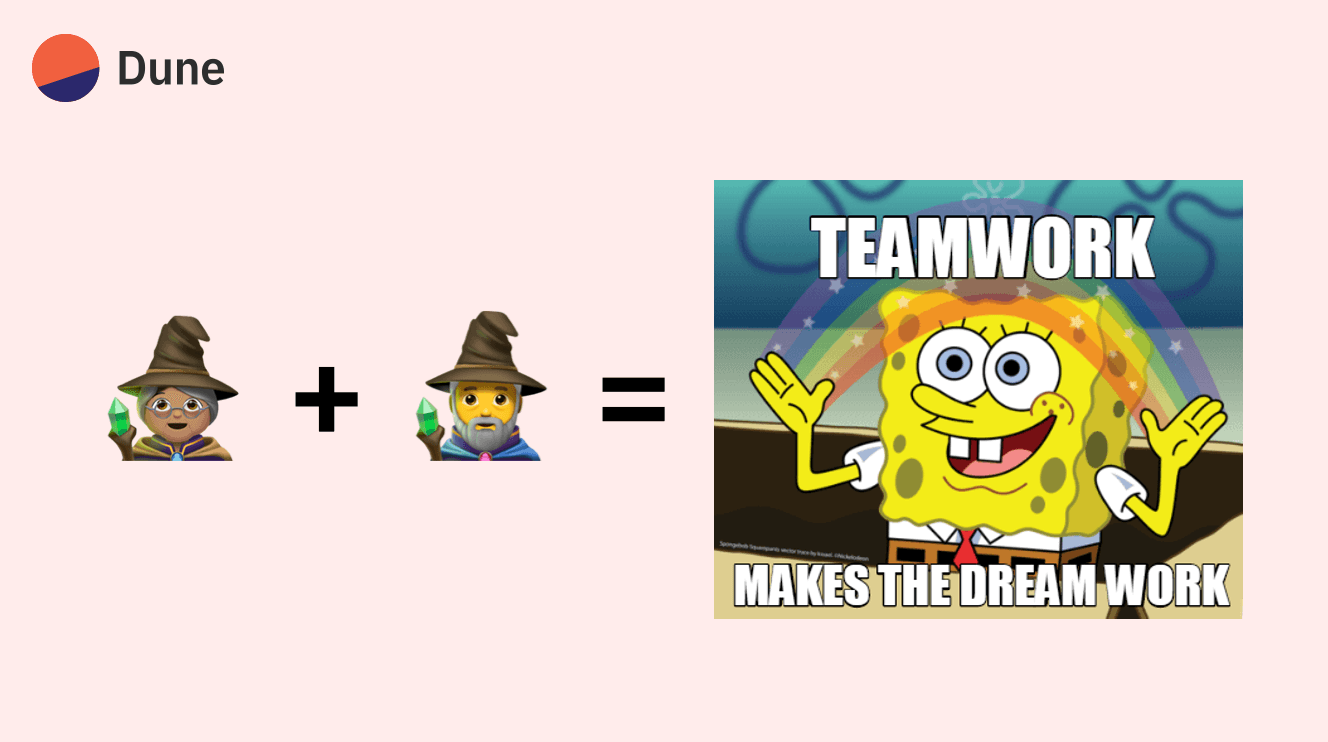
The ability to work together in teams has long been one of the most requested features on Dune.
It's a natural extension of the collaborative work that's already happening between groups of Wizards, both in official and unofficial capacities.
We introduced Teams to make this cross-pollination process between our users easier, smoother and more fun!
Teams has now been publicly available for less than two months.
More than 170 Teams of Wizards (of varying shapes and sizes) have signed up since then and have been creating some truly outstanding content.
With the growing traction of Teams among Wizards, we feel that this is a good time to have a closer look at what Teams are, why we were motivated to create them in the first place, & who they are for.
We'll also look at some of the most interesting examples of Teams we have seen so far.....
Ready? Let’s jump right in!
A New Era in Wizard Collaboration
Shared Workspaces. Teams are Dune’s shared workspaces. Teams allow Wizards to effortlessly collaborate with each other, openly or in private, and present their work under a single shared identity.
Dedicated, but Flexible Content. Teams have their own dedicated profiles that own and showcase content. This content can be completely new (like a new dashboard created from scratch by one or more members of the Team), old (like an old query created by one of the Team members individually is transferred to the Team and added in a new Team dashboard), or any combination of the two.
Why Teams?
From billion dollar protocols that can co-create and share their official content from one single profile to DAOs that want to offer an easier way for their community members to track and update key ecosystem statistics to new projects that want to build on their trustworthiness and enhance their brand's reputation, working with Teams offers serious benefits:
Seamless Collaboration. This lies at the core of open data and financial transparency that Dune is spearheading. We want to make it easier for users to work with one another, learn from each other, combine their strengths, and have more time to focus on actual data analysis.
The Law of Wizard Attraction. Great Wizards attract great Wizards. Showcasing high quality group dashboards can act as a profile-raising mechanism that will bring more top level Wizards into particular ecosystems, networks, protocols, projects or teams of on-chain analysts.
Everything organized under one Magic Hat. The ability to have all of a Team’s content in one place can be a powerful way to organize existing work and help consumers (viewers and analysts) of particular data find any information they are looking for much easier and faster.
Wisdom of the Wizard Crowd. Having more working hands and eyes on top of queries and dashboards does not only help cross-check existing work and spot potential mistakes earlier, it also allows for a larger pool of creative and innovative people to build something new together. Leveraging the collective opinions, experiences and knowledge of a diverse group of individuals (rather than that of a single expert) can help produce much more impactful results.
Who did we Build Teams for?
Teams are Dune's on-chain data collaboration engines. Dune Teams aim to help pretty much anyone interested in on-chain data and open finance – blockchain protocols, crypto-focused companies, web3 startups, research houses, Wizard collectives, smart contract projects, data enthusiasts, governance specialists and students – to highlight their group work.
Veterans and newbies benefit from Teams alike. Teams can help established groups that have gradually seen their number of Dune users (and viewers) increase and want to up their collective blockchain data efforts, as well as new ones that want to leverage the power of blockchain analytics to showcase their team’s efforts and make a name for themselves.
Size (and type) does not matter. Your Team can be as big (e.g., an armada of 100 Wizards) or as small (e.g., a one-man show) as you want, and can cover any topic or focus area.
Top Teams (so far)
A number of respected teams in crypto have started developing stellar work on their Team profiles. Some of the most interesting collaborative work produced so far can be found below:
Networks
Only the Beginning
At Dune, we are very excited about the cross-collaborative future that Teams can help unlock and are committed to turning this into the predominant tool for group work in the blockchain analytics space.
We are also adamant in helping any group of Wizards succeed on Teams, which is why we would love to get your feedback about the product. Feel free to reach out on our Discord (#feedback channel) or create a post here.
Stay tuned – there's much more to come!