$NAT on Ethereum: a native Bitcoin token, bridged
 @bitcoinsecuritybudget13 charts
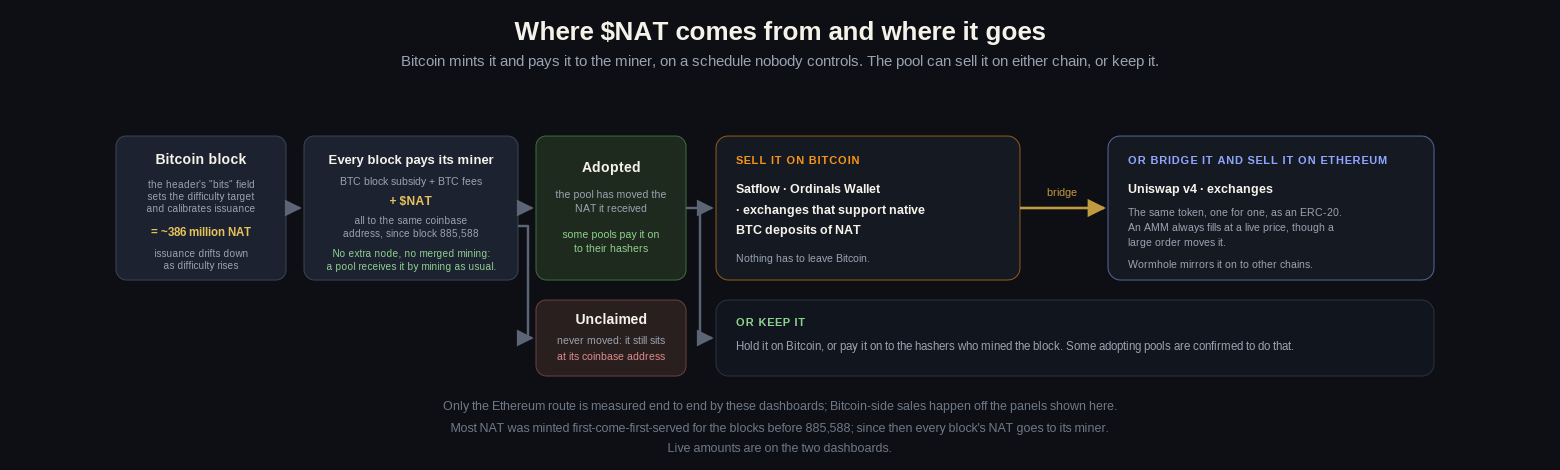
How NAT gets here and moves: the bridge
NAT reaches Ethereum as a one-for-one ERC-20 representation of the Bitcoin-side token. Wormhole carries it onward from here: tokens locked in the Wormhole contract on Ethereum are the ones held as copies on other chains, so the contract balance is a live count of NAT that has left Ethereum again (about 13T today). Daily transfers count every ERC-20 movement on Ethereum, wallets, pools and the bridge alike, so a burst here usually means trading or bridging, not new holders. Nearly all NAT movement happens on Ethereum; on Bitcoin itself only a few hundred transfer inscriptions have ever been made.
Why a Bitcoin token is on Ethereum, and why it exists at all
NAT is created on Bitcoin, by every block, for the miner who mined it. It lives here because Bitcoin cannot trade or easily hold it: on Bitcoin, NAT is a TAP inscription tied to one UTXO, each transfer a fresh transaction paying BTC fees, settled every ten minutes, with no contract able to quote a price or hold a pool. Bitcoin-native marketplaces for TAP and ordinals tokens exist, but they are order books of listed offers, not automated market makers: a buyer waits for a matching seller, and a fill is never certain. Holding it means an ordinals-aware wallet and care not to spend the inscribed sat as change. Ethereum gives it what Bitcoin cannot: a Uniswap v4 pool that quotes a live price and always fills, with no waiting for a counterparty, though large orders move the price since pool inventory is finite, so a miner or pool can turn the subsidy into ETH or dollars; contract-enforced balances any wallet, explorer, or exchange can read; a plain ERC-20 that sits on a standard Ledger or Trezor like any other token; transfers that cost cents; and the option to be pooled or held as collateral. The Bitcoin-side inscriptions behind it are held, not destroyed, so about 124T of the 396T ever minted lives here and nothing is created. The reason NAT exists is the security budget: fees are under 1% of what Bitcoin pays its miners, and the Bitcoin Security Index (annualised miner revenue over market cap) has sat below the 1% line since the April 2024 halving; both series since 2010 are below. NAT is a second subsidy, paid on top of the BTC reward. The miner side lives on the companion dashboard, Bitcoin's second subsidy.
Where it trades: Uniswap v4
The trading measured here is Uniswap v4, where most on-chain NAT volume sits: mostly ETH/NAT at the 1% fee tier, with USDC/NAT second. Other venues, including centralised exchanges, are not covered by these panels. Weekly volume by pool shows where liquidity actually sits; pools under 1% of the window's volume are grouped as Other. The daily chart follows the main ETH/NAT pool, the 30-day table ranks every pool by share, and the inventory table lists every Uniswap v4 pool ever created for NAT, with fee tier, tick spacing, hooks and lifetime swap count, including the ones that have never traded. These pools also set the price the Bitcoin dashboard uses to value what a miner earns per block, so thin weeks here show up as noise there.
Who holds it
The holder count and the top 20 addresses on the Ethereum side, each with its share of NAT on Ethereum and of all NAT ever minted. The largest holders are contracts rather than people: the Wormhole bridge (NAT held elsewhere as copies) and the Uniswap v4 PoolManager (NAT sitting in pools). First-time wallets per week shows whether new holders are still arriving, counted from each address's first ever NAT receipt. Labels are best effort; anything unlabelled is a plain wallet.
$NAT on Ethereum: a native Bitcoin token, bridged
- NAT is minted on Bitcoin. Every Bitcoin block creates about 386 million NAT, set by the block header's difficulty field. Nothing here is issued on Ethereum.
- This ERC-20 is the bridged representation of that token. About 124T of the 396T NAT ever minted sits on Ethereum; about 13T of it is locked in Wormhole and mirrored on other chains.
- Where it trades: Uniswap v4, mostly the ETH/NAT 1% pool, with USDC/NAT second. This is the only place NAT has an automated market maker: on Bitcoin it is a TAP inscription, and the Bitcoin-native marketplaces for TAP and ordinals tokens are order books of listed offers, so a buyer waits for a matching seller and a fill is never certain. Here a trade always fills at a live price without waiting for a counterparty, though large orders move it, and hold the plain ERC-20 on a standard hardware wallet.
- Issuance, mining pools and unclaimed balances live on the companion page: Bitcoin's second subsidy.
How to read it. Panels are denominated in NAT (0 decimals), ETH or percentages. No dollar figures and no forecasts on this page. Daily and weekly charts exclude the partial current day or week. Every panel links to its SQL. Glossary at the bottom.
Glossary
- NAT — the token. Minted by every Bitcoin block under the TAP Protocol's "DMT" rule; 0 decimals, so 1 NAT is the smallest unit.
- bits — a 4-byte field in every Bitcoin block header that encodes the mining difficulty target. NAT's per-block amount is computed from it: exponent × 2^24 + mantissa, about 386 million today. Because difficulty rises it drifts down about 1% a year; there is no halving and no fixed cap.
- epoch — a run of 2,016 blocks (about two weeks) with one difficulty, so one NAT-per-block value.
- credited — since block 885,588 the block's NAT is assigned to the pool that mined the block, automatically.
- adopting pool — a mining pool that has moved the NAT that arrived at its coinbase address, i.e. it has used the second subsidy. Five today: AntPool, F2Pool, ViaBTC, SpiderPool, Luxor.
- distributing pool — an adopting pool that also passes its NAT on to its hashers. Confirmed so far: F2Pool and SpiderPool. Distribution is an off-chain pool policy, checked by hand, not read from the chain.
- unclaimed — NAT credited to a pool that has not adopted. It sits untouched at that pool's coinbase address; nobody else can take it.
- the redirect / block 885,588 — the block from which NAT goes to miners instead of being minted first-come-first-served.
- first-come-first-served (FCFS) — how the NAT of blocks before 885,588 was minted: anyone could inscribe a claim for a block, so about 364T NAT was minted that way between November 2023 and February 2025.
- bridged / ERC-20 — the Ethereum token at 0x2491… that represents NAT on Ethereum. Same asset, different chain.
- Wormhole — a bridge contract. NAT sent into it is locked on Ethereum and a matching amount is minted on another chain, so its balance is NAT living elsewhere.
- Uniswap v4 / PoolManager — the exchange where the ERC-20 trades; PoolManager is the single contract that holds every pool's liquidity.
- second subsidy — the project's phrase for NAT as a second income stream for miners beside the BTC block reward, hence the Bitcoin dashboard's name.